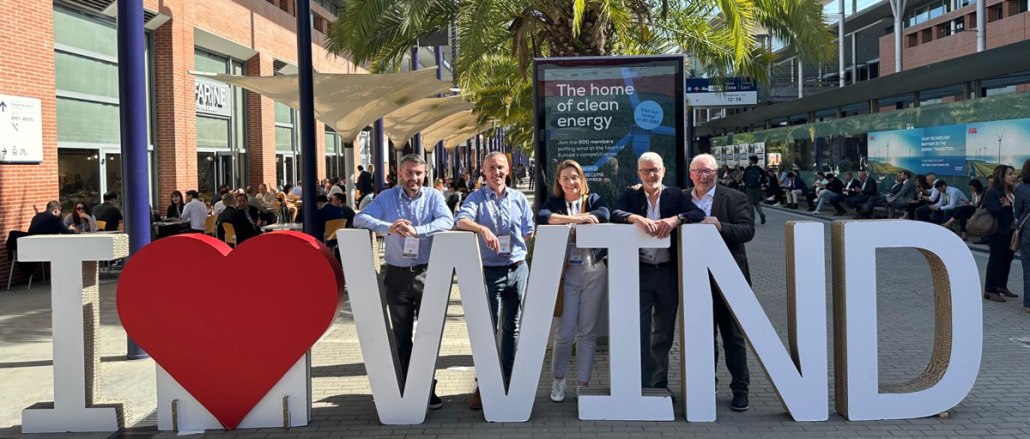
South East delegation to WindEurope hears of need for accelerated deployment of offshore wind
The South East of Ireland is poised to play a central role in delivering the country’s renewable energy ambitions, a message strongly reinforced by the regional delegation attending the WindEurope Annual Event 2026 in Madrid this week.
Representing the South East were stakeholders from the Ireland South East Offshore Wind Partnership, South East Technological University, Eastgate Engineering, the Engineering the South East cluster and the South East Regional Enterprise Plan.
Darragh O’Brien, Minister for Climate, Energy and the Environment, and Timmy Dooley, Minister of State with responsibility for Marine Planning, set out the Government’s ambition to accelerate renewable energy deployment ahead of Ireland’s upcoming EU Presidency.
The conference, attended by over 16,000 delegates, 400 speakers and 600 exhibitors, highlighted the urgent need to scale up wind energy and supporting infrastructure in response to global energy instability. For the South East, this ambition directly aligns with the region’s growing role as a national hub for offshore wind development.
South East Opportunity in Focus
The South East is uniquely positioned to benefit from this accelerated push, with significant offshore wind potential identified under Ireland’s South Coast maritime plans, alongside critical enabling infrastructure including the Ports of Waterford and Rosslare Europort.
Regional stakeholders attending WindEurope reinforced the message that the South East is ready to support:
- The development of offshore wind projects at scale
- The growth of a competitive Irish supply chain
- The attraction of large energy users through green energy availability
- Skills and workforce development aligned to industry demand
This aligns closely with national policy, including the Government’s offshore wind industrial strategy Powering Prosperity, and ongoing work to develop Green Energy Parks that can anchor investment and job creation in regions like the South East.
Government Signals Acceleration
Speaking at the conference, Minister O’Brien emphasised the strategic importance of renewable energy:
Energy markets and prices are directly impacted by events far beyond our borders. Reducing our exposure to volatile fossil fuel markets will strengthen Europe’s strategic autonomy. It is essential that we accelerate deployment of grid networks and interconnection at scale – to underpin the EU’s competitiveness, drive down consumer costs, and ensure energy security.
Minister Dooley highlighted the urgency of action:
The ongoing conflict in the Middle East underlines once again why Ireland and Europe must speed up the deployment of renewables and investment in our grid networks. The Grids Package will be a central priority during Ireland’s EU Presidency.
Strengthening Ireland’s International Position
A key milestone at the event will see Ireland strengthen international energy cooperation, with Minister O’Brien set to sign a Memorandum of Understanding with Spain on the development of a new electricity interconnector—further enhancing Ireland’s integration into European energy markets.
Meanwhile, at the Ireland Pavilion, Enterprise Ireland launched the Propel Ireland Wind Centre of Excellence, alongside an update on the Powering Prosperity strategy—highlighting Ireland’s progress in building a robust offshore wind industry.
Electrification a Strategic Priority
The conference also saw the launch of the Madrid Call to Action, urging EU leaders to treat electrification as a strategic priority. For the South East, this reinforces the importance of continued investment in grid infrastructure, renewable generation, and industry clustering to fully realise the region’s potential.
A Defining Moment for the South East
As Ireland prepares to take on the EU Presidency, the signals from WindEurope 2026 are clear: delivery must accelerate, and regions like the South East will be central to that success.
With strong natural resources, growing infrastructure, and an increasingly coordinated regional ecosystem, the South East is well positioned not only to support Ireland’s energy transition—but to lead it.

