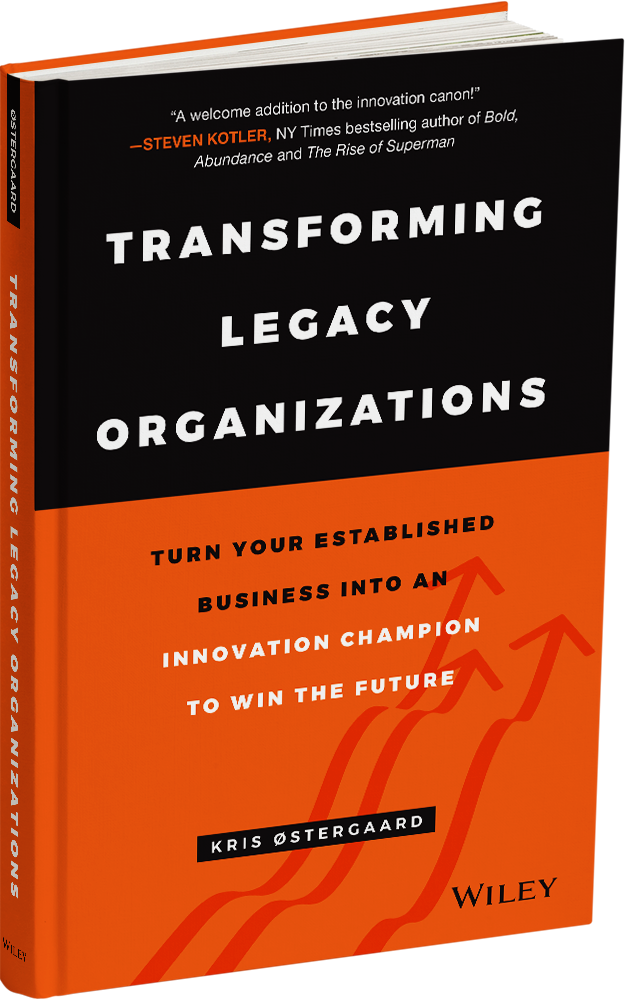
“Transforming Legacy Organisations: Turn your Established Business into an Innovation Champion to Win the Future”.
As part of the literature review for the intrapreneurship project Ron Immink has reviewed the book: “Transforming Legacy Organisations: Turn your Established Business into an Innovation Champion to Win the Future”.
A version of “Creative construction”. The book also starts with the premise that innovation is much more difficult in established organisations than it is in startups. The most important job for a startup is to focus on its (probably one) product and to subsequently scale-up. The established organisations have to entertain many more considerations with their complicated product portfolios and business structures. However, nobody is more likely to succeed in their innovation efforts than established organisations. Of all startups, 70% fail within approximately 20 months of their first venture round, and there is an overall higher risk of being hit by lightning (about 1: 700,000) than there is of creating a unicorn.
Innovation and design
Innovation is the act of creating something new and having it materialise. However, simply thinking fresh and having ideas is not enough. The ideas should be realisable. The ideas do not materialise because the organisation lacks a well-functioning innovation design. According to the Oxford Dictionary, design is defined as ‘the art or the action of inventing and creating a plan or sketch of something before executing on it’. And innovation design is exactly that: A plan for how to shape your innovations so that you don’t leave its success to chance.
The options
According to the book, you have three options: optimising, augmenting, and mutating innovation.
- The first track is optimising innovation. This type of innovation is the majority of what established organisations already do today. This is where the established player reigns. No startup with so much as a modicum of sense would even try to beat the established company in that type of innovation.
- Therefore, the established players must also focus on the second track: augmenting innovation. In the first instance, it is about upgrading the organisations and their core services and processes from analogue to digital. When it comes to augmenting innovation, the biggest challenge is probably culture. To achieve success with augmenting innovation and to create the right culture, an organisation needs to thoroughly understand its immune systems. Augmenting innovation is crucial if you want success in the medium term.
- The business that maintains, or exceeds, its level of success 10, 20, 30 years from now will have mutated and will look significantly different than it does today. Mutating innovation requires a bold focus on experimenting with that which is not currently understood.
Innovation theatre
For far too often, experience expeditions, hackathons, and accelerator programmes end up being singular events that do not materialise into anything of real value. They end up becoming innovation theatre rather than creating an innovation culture. The world is no longer local and linear. It is global and exponential, thanks to the technological achievements that have largely been sustained by Moore’s law. Established organisations tend to do one of two things. Either they are dismissive of whatever is new and different because these things are almost by definition difficult to fit into existing strategies. Alternatively, organisations recognise, on some level, that they should explore new things, but they don’t do it thoroughly, ambitiously, and strategically enough.
The importance of a narrative
The human brain processes many millions of bits per second, but only a fraction of the signals reach our consciousness. We have filters to do that for us. Some of the key filters that sort out signals to the brain are human biases. The problem is that the rules of thumb, that we believe are helpful to us, are very often wrong.
- We all have an optimism bias, which means that we, as humans, are overoptimistic about our own future. We also have a proximity bias that causes us to interpret events that have happened recently as more likely than events that happened a long time ago.
- We also have a confirmation bias. This means that we mostly listen to information that confirms our pre-existing convictions (a bias that social media helps to reinforce).
- Then we have a hindsight bias that causes us to exaggerate our ‘I-knew-this-would-happen’ response after an event has taken place.
- ‘Sunk-cost fallacy’ is a type of bias that makes it very hard to give something up once we’ve invested a large amount of time or money in it, even when it would be the right thing to do.
Therefore people need to be persuaded with strong arguments to participate in projects where the result is unknown. And that is always the case when we talk about innovation. Therefore, the brain also pays more attention to the greater narrative and how well it is told than it does to concrete facts and to the likelihood that the stories we are told are true. Read “Putting stories to work”.
MTP
You need a massive transformative purpose. Having an MTP is the same as having a big story in your organisation. Massive transformative purposes are far stronger motivators for people than monetary rewards. Analyses showed that there is a correlation between the experience of a higher purpose and the economic results of those organisations where there were also clear objectives from management. Read “Exponential organisations”. Narratives, storytelling in the form of a greater purpose for the organisation, and a massive transformative purpose motivate us as human beings and help us overcome some of our biases, one of the most important being our status quo bias, which slows us in our development and innovation. Therefore, organisations should find their great story and incorporate it into their culture and workflows.
What business are you in?
Once upon a time, the question ‘Which industry am I really in?’ was easy to answer. Amazon for example. Amazon was initially a bookseller that sold physical books online. However, in 2007, they launched Kindle, the e-reader for digital books. Amazon’s need to find new data storage solutions grew massively. Therefore, they invented Amazon Web Services or AWS (data storage in the cloud). With extensive digitisation, Amazon’s need to establish data centres also increased, and data centres need large amounts of energy. So Amazon created Amazon Wind Power, also includes the hugely successful Echo, the device that provides a customer-facing artificial intelligence service through Alexa. Amazon has also established Amazon Studios, which produces movies and shows, and has even won its first Oscars. North America’s second-largest fashion outlet is owned by Amazon; it also serves as a third-party distribution centre for the world’s big and small product manufacturers. Amazon has even invested in its first biotech company, Grail, which is working to develop new methods for diagnosing cancer. In other words, Amazon continuously reinvents – or mutates – the organisation to make it stronger and more competitive by constantly exploring what further actions they can take to translate their skills into value to customers. Read “The four” and particularly the story about Amazon. Awesome and scary all at the same time.
What do your customers want?
The four core motivations are BE, DO, FEEL, and LOOK with the common denominator ‘better’, because all of our core motivations share the fact that they are part of mankind’s fundamental drive towards self-improvement. Which box do you tick?
Who are your competitors?
No fintech startup in its right mind has the strategy of disrupting a bank. No gifted insurtech startup starts out wanting to make insurance companies redundant. The question to ask yourself as a startup is not how to disrupt a business. The question is how to eat an elephant, and the answer is, as you know: one bite at a time. And you can rest assured that, for each service and for each product that exists in your company’s product portfolio, there are – literally – hundreds of startups worldwide, maybe even thousands, working to provide exactly that service or product at least ten times better. Do you know all the thousands of startups that challenge your company’s products and services on the international stage? You should establish partnerships with the ecosystems that actually know the many thousands of entrepreneurs. Not only to identify potential future competitors, but also to identify potential future partners, so they won’t have to reinvent the wheel themselves.
The six degrees of competition
But even when the big organisations scan the startup world for potential competitors, they are still only scratching the surface of the competitive landscape. If you take the ‘small world’ principle and apply it to your competitors, something interesting happens. Take one core product or service as a starting point. Ask: Who would be competitors in the second, third, fourth, fifth and sixth degree. I will open a whole new world.
Coffee
For example, what is the 3rd-degree competitor to ground coffee beans? Think about what products like Thync and Muse or other similar products on the market are going to do to coffee cup no. 3, 4, 5, and 6 over the course of a day if you, instead of grabbing a cup of coffee and a Snickers bar at 3 p.m. for a few extra hours of focus, put on your wearable for ten minutes and reap the same rewards. And the products available today are only version 1.0. Imagine where we might be headed. Who could be the sixth degree of competition to 400 grams of ground coffee beans from Folgers? Electric cars and self-driving cars will massively impact the coffee producers’ value chain. Because where is a large proportion of the revenue of coffee producers, Starbucks, and Red Bull coming from? From gas stations.
Go deep
Are the board members of the coffee producers discussing Thync, Muse, electric and self-driving cars? They never go further than the second, third, or maximum fourth degree before feeling confident they have an overview of their competitors. However, Red Bull does. They continually explore the fifth, sixth, and maybe even the seventh degree of competition to make sure they understand threats and opportunities so they can prepare themselves properly for the future. Take your own core product and go through the same exercise. Ask yourself: ‘How do you digitise a cup of coffee?’ Who are your competitors in the fourth, fifth, and sixth-degree? The CEO, Reed Hastings, is known to have said that Netflix’s biggest competitor is sleep.
What are the risk profiles of your staff?
Because it shows that we as human beings have fundamentally different risk profiles, which is the first of three crucial parameters that defines the individual immune system. The majority of us are programmed, or ‘wired’ as brain researchers call it, to seek out stability and status quo. The minority seek out change and innovation. We are just different, and this plays a role in our daily actions at the workplace – not least in our actions when it comes to innovation projects or change processes. All three parameters of the individual immune system – personality profile, psychological barriers, and level of capabilities – are essential when a company evaluates how to overcome the barriers that stem from the individual immune system and to strengthen the organisation’s potential for innovation.
What are the metrics
Think of the prisoner’s dilemma, and replace the prison with your company and the prisoners with your employees. As a leader, you can actually promote the conduct required on behalf of the organisation, but only if the system is adapted to the reality you want to create. If the system is not adapted to the goals, it doesn’t matter how much you talk about wanting change; it’s not going to happen. You can start by designing the right metrics. Instead of designing your measurement points based on a logic that assumes that there is always a direct connection between the measurement point and the end result (‘we want to increase sales, so we only measure the number of units sold’), you should also develop your measurement points based on an indirect correlation between measurement points and end results.
The system
As a leader, you need to be very aware of the system’s power over the results. Regardless of the strategy you apply as a leader, or the measurement points you choose, and the stories you tell, you will not achieve the desired results if you do not develop the system for the future you want to create. The two killers:
- ‘Great idea. We must do that. But could you just run it past Legal?’ THUMP.
- ‘Super idea. We must do that. We just need to make sure it’s compatible with IT.’ THUMP.
You should read “Thinking in systems“.
Think 2050
Investors and shareholders have been taught to prioritise growth over earnings. As a CEO or a senior executive of a legacy organisation, you probably can’t convince your investors and shareholders to think like that. The Vision Fund, Softbank’s investment company, which has raised an incredible $100 billion, and, at the time of writing this, is said to be raising another 100-billion-dollar fund, has a 300-year time horizon. You should think 30 years into the future and find out how your company can do experiments today that optimise your potential to play an important role in the world in 2050.
The immune system
The societal immune system comes into force when new business models pop up and gain so much popularity that they become mainstream. The struggle between the old and new business models, where the weapons of choice are lobbyism and legislation, is by no means new. There are three key parameters in the societal immune system that you must address if you want to strengthen your innovative power. Legislation, legacy customers and suppliers and the general economic climate.
- In the 1970s and 1980s, there was a ban on setting up satellite dishes in Denmark, to protect the Danish television monopoly of the time.
- In Sweden, there was a ban on cordless phones in the 1980s to protect the monopoly’s fixed-line solutions.
- In order to protect car dealers, direct sales of cars by the manufacturer are prohibited in several US states (response to Tesla’s sales model)
The societal immune system is almost always the strongest. The societal immune system is also almost always a friend of the well-established, traditional company.
Augmenting innovation
‘Marketing is the price you pay for being unremarkable.’ Too many focus groups and questionnaire-based surveys have been conducted to help companies identify how they can escape their innovation issues through marketing. Because the majority of resources go to operations, and to putting out proverbial fires, the technological debt, which every legacy organisation knows only too well, accumulates year on year. Augmenting innovation adds an extra layer to organisations that upgrade their cores. Initially, it’s a digital layer over the analogue cores of organisations, followed by necessary upgrades via, e.g. mobile technology, artificial intelligence, blockchains, and so forth in a continuous process. Augmenting innovation is about upgrading your core, whether it’s a case of upgrading products or internal processes.
Upgrades
This is followed by new upgrades that will, in principle, be infinite in number, as there will always be new technological achievements that can be used to create better solutions. For example, companies become ‘mobile-first” Followed by AI-first’. After artificial intelligence, you could start to envision a ‘quantum-first’ phase. What do you think will there be after quantum?
GE Digital
The book uses GE Digital as an example. Each business unit was established with a Chief Digital Officer function, who reported both to their own business unit and to the overall digital management team, in order to optimise the potential for synergies. The next step was to connect existing infrastructure, software stacks and processes to collect and process future data, and to ensure integration between business units and departments within individual business units so that the backend and frontend could work together. But process optimisation was not just about connecting and optimising internal processes. On the contrary, they expanded their partner-ecosystem with an open innovation mindset and established partner programmes, because 49% of the most important product innovations in manufacturing companies actually originate from input from external sources, moving from making internally directed process optimisations to engaging in externally targeted product optimisations and developments, a cultural journey was initiated that entailed the introduction of a new set of values called ‘GE Beliefs’. This work was anchored in a method that GE calls FastWorks, and that is best described as the lean startup method.
Radical innovation
Many established organisations have a status quo culture, Radical innovators are a special type of people who have a high tolerance for risk. They are overrepresented among startup founders and people who practise extreme sports. You probably have valuable unidentified capabilities in the organisation in the form of radical innovators who, if they had the right framework to work within, could achieve not only true job satisfaction but real success for the organisation when it comes to mutating innovation.
We can all do it
In fact, everyone possesses the ability to be good innovators. As five-year-olds, 98% of the children were considered to be creative geniuses, but over time, their natural creativity levels fell. Among 10-year-olds, the percentage had already fallen to 32%, among 15-year-olds they were down to 10%, and among adults, only 2% were creative geniuses. Read “The runaway species”. There is hope for us all.
Shake it up
As citizens, we unlearn our skills of divergent thinking, and most of our organisations are built to promote and maintain this state. So you need to shake it up.
- The first support tool comprises the environment. That’s everything you can see, hear, smell, feel, and taste. Office interiors play a surprisingly significant role: lighting, sounds, scents, and decor. All of it affects us as human beings; largely on an unconscious level, but with great importance to our productivity, innovation power, and job satisfaction.
- The second support tool, the agents, are ourselves, and the agents we interact with. Agents can be divided into two parts, internal and external agents.
- The third support tool consists of processes – that is, the ways we do things. The flows we go through from point A to point B to point C, and the tools we use.
The examples
- Grundfos’s digital factory changes its layout on a regular basis, so that employees continuously experience change. Neurology research shows that change, under the right circumstances, creates enthusiasm. People have a reaction pattern called repetition suppression, which means that every time the brain is exposed to the same stimuli, it reacts less to them. Shaking things up every now and again stirs up the mind and our curiosity, and we get that bit more excited. This is good for innovation.
- Google’s Project Aristotle also revealed that reliability (ensuring team members adhere to their agreements), structure and clarity (knowing their role, plans, and goals), meaning (finding that your work is meaningful) and impact (that you feel that your work has a greater societal significance) are crucial parameters, but psychological safety was the most crucial factor for high-performing teams.
- According to Henrik Stenmann, IIH Nordic’s CEO, the introduction of the Pomodoro technique, along with a focus on healthier meals in the canteen and a reduction in working time from 37 to 30 weekly hours (they have Fridays off), resulted in a productivity increase of 20%, a halving of absence due to illness, and an increase in the company’s so-called ‘wellness score’ by 70%.25
- ‘Digifunds’. Here, the employees have been invited to submit ideas for supply chain improvements that could be implemented for 10,000 euros or less. So, small innovations. The call was super-simple: submit a maximum four-minute-long video, answer three questions, and after 48 hours, you’ll be informed whether or not you will get the money to develop the idea.
- In the BIG programme, a team can win a pot of money, which they get three months to spend on testing an idea and building a Minimum Viable Product (MVP). The money is primarily used to buy internal resources’ free’, but also covers expenses like hardware, software, or other expenses that a startup might have.
- ‘The 10,000 Stories-Challenge’. The aim was to make the connection between the company’s purpose and the daily work of the employees visible.
- Google holds ‘Thank God It’s Friday’ Town Halls every week, where the entire company globally meets, both physically and virtually, to be briefed by senior management and everyone gets the opportunity to ask questions.
- In Amazon, you don’t produce long PowerPoints to sell your ideas to management. Instead, you write an essay of a maximum of six pages.
- Amazon has also invented the institutional ‘yes’, which means that if a boss rejects a project idea from an employee, they should write a two-page-long argument about why they’ve said no and publish it on the intranet. With this rule, a boss thinks twice before saying no,36 giving the idea the attention it deserves.
- Google X hands out what they call ‘The Get Weird Award’. The prize is given to the teams who choose to explore the strangest or most unconventional hypothesis.
- The marketing software company HubSpot holds ‘mystery dinners’ where different people from the company who do not know each other are put together to share a meal somewhere in the city.
- The file storage company Dropbox holds an annual hackathon for all its employees.
- IBM in the Nordic region holds reverse mentor sessions, where senior executives shadow young employees for a half to a whole day to understand them better and to create a stronger culture.
- More and more companies are setting up so-called academies where they regularly organise lectures and courses, where all employees can get inspiration and further training on topics that are both directly work-related and focused on personal development.
- Some companies have dedicated resources to enable all employees to spend working hours on coaching sessions with a professional coach
- Maersk Growth, Maersk’s venture arm, has set up a ‘culture club’ that investigates what kind of culture employees want, and how they establish cohesion with the Maersk organisation’s set of values.
- They also have ‘growth corners’, which are half-day events, where employees can pitch new ideas, experts are invited to hold talks, or you can take the microphone and talk about what’s on your mind.
Mutating innovation
This is where you’re no longer improving the past, as with optimising innovation, or preparing the future, as with augmenting innovation, but where you invent the future. As an employee, you are either working to optimise or upgrade what currently exists (optimising or augmenting innovation), or you are working to challenge it (mutating innovation). So when you hear managers say to employees within the core organisation that they must disrupt themselves, it basically means that they should start sawing off the branch they are sitting on. It can’t succeed.
Lowe Innovation labs
“Back to the present” is the creation of Lowe’s Innovation Labs, an independent entity funded by the parent company, but operating independently of the headquarters. Lowe’s Innovation Labs distinguishes itself further by working with a method that they call narrative-driven innovation, where you work your way back to today’s solutions by developing science fiction scenarios to inspire the company’s strategy work. The starting point for their method leads us back to What Is the Purpose?’ People are driven by stories. The stories we tell each other enable us to understand each other’s motives and to sense potential based on things beyond purely rational parameters.
Science fiction
In order to motivate senior management to conduct radical experiments and challenge the core organisation that they work so hard to protect, you need to have a compelling story. This is why Lowe’s Innovation Labs began to produce science fiction comics for their senior management. Professional science fiction writers were given market and megatrend analyses from Lowe’s analysis departments and asked to use this data to develop scenarios that illustrated how Lowe’s customers’ lives could look ten years into the future. Professional science fiction writers were hired to ensure that they wouldn’t just get traditional PowerPoint presentations back, but the development of narratives with protagonists, dilemmas, and solutions, the way we see them in novels and movies. Finally, the stories were conveyed in comic book format, using the power of visualising possible solutions, in order to surprise senior management with the alternative format.
EEG
Prototypes were continuously tested on users using observations, eye tracking, and EEG studies. It wouldn’t have been possible to reveal these findings using regular survey techniques because a person’s reactions happen unconsciously and therefore, per definition, can’t be relayed by the individual respondent.
AR/VR
They developed virtual and augmented reality rooms in a number of Lowe’s DIY stores to experiment with the possibility that customers could enter these spaces, use the technology to insert Lowe’s products into their own virtual homes, and, hence, make better purchasing decisions.
Partners
The best step turned out to be finding the right partners who could help them on their way because they would possess technological skills that the organisation did not have. It also turned out that the right partners would be what Kyle calls ‘uncommon partners’. You could ask yourself why Lowe’s, a large, old-fashioned DIY chain, decided to spend time and money developing a 3D printer that works in space, besides the fact that space is, of course, the next trillion-dollar market. The answer is that while developing 3D printers for space, experiences were gained that enabled the lab to develop 3D services for Lowe’s own stores, allowing customers to print personalised solutions which hadn’t been possible before.
Maersk Growth
The logistics giant Maersk has also established their version of an X division called Maersk Growth, work, which looked at megatrends and their expected impact on the world in 2030–2050 to identify the biggest long-term potentials. The idea is that this self-contained Growth unit can get resources, special data, customers, and testing opportunities from the parent company while allowing the unit to operate with the agility of a startup and, not least, to set up systems for the parent organisation’s entrepreneurial initiatives. It turned out that when they carried out their initial analyses, there was a sea of different entrepreneurship projects in the Maersk organisation. They found a total of 41 different initiatives covering everything from mobile internet in Africa to new fuel types and autonomous ships. But all the work was without structure, driven by individuals’ energy and entrepreneurial spirits, without a strategic support system to support development, and without specific measurement points and success parameters.
Pivot
Maersk Growth initially served the purpose of building companies from scratch, but this proved extremely difficult because it required its few employees to generate the right ideas themselves, qualify these ideas, put together the right team that was motivated enough to work on the projects as corporate founders and work on scaling them. Therefore, growth ended up pivoting, as it is called in the world of entrepreneurship, which means that they changed strategy and decided to focus 90% of their energy on investment and only 10% on building projects from scratch. Another discovery that Maersk Growth made was that it is necessary to define the right purpose of your initiatives. That you should always begin your experiments on a small scale. And that partnerships are crucial to this success, including those between established organisations, such as Maersk’s cooperation with IBM; those between established organisations and universities such as Caterpillar and Emerson; and those between established organisations and startups.
Superfluid
The loonshots. As always, Google is used as an example. Sidewalk Labs which works to develop intelligent cities; Calico, aimed at radically increasing people’s lifespans; DeepMind, which conducts research in artificial intelligence. The Loon project develops air balloons, which can be sent all the way up to the stratosphere, and transmit WiFi to strategically positioned receivers from there. The Loon project develops air balloons, which can be sent all the way up to the stratosphere, and transmit WiFi to strategically positioned receivers from there.
Google Ventures, Alphabet’s investment company and X, the organisation’s ‘moonshot factory’. If experiments prove viable, they are separated from the moonshot factory and are to stand on their own feet. However, this also means that until projects have graduated from X, no attention is paid to business models and expected financial results, which is generally a classic mistake that many companies make with their experiments.
Buying start-ups
TomTom, especially known for their GPSs, has recently bought the Berlin-based self-driving automotive software company Autonomous. The microchip manufacturer Intel recently bought the self-driving car company Mobileye for more than $15 billion. What this development also shows is that one of the fastest ways to mutate an organisation and explore radically new business areas that potentially challenge the company’s existing core is through acquisitions.
Full circle
Which is where the book brings us full circle. Intrapreneurship of entrepreneurship? What do you think?


Trackbacks & Pingbacks
… [Trackback]
[…] Find More on to that Topic: irelandsoutheast.com/transforming-legacy-organisations-turn-your-established-business-into-an-innovation-champion-to-win-the-future/ […]
… [Trackback]
[…] Read More to that Topic: irelandsoutheast.com/transforming-legacy-organisations-turn-your-established-business-into-an-innovation-champion-to-win-the-future/ […]
… [Trackback]
[…] Read More Info here on that Topic: irelandsoutheast.com/transforming-legacy-organisations-turn-your-established-business-into-an-innovation-champion-to-win-the-future/ […]
… [Trackback]
[…] Read More here on that Topic: irelandsoutheast.com/transforming-legacy-organisations-turn-your-established-business-into-an-innovation-champion-to-win-the-future/ […]
… [Trackback]
[…] Here you will find 9430 additional Information to that Topic: irelandsoutheast.com/transforming-legacy-organisations-turn-your-established-business-into-an-innovation-champion-to-win-the-future/ […]
… [Trackback]
[…] Information on that Topic: irelandsoutheast.com/2021/01/13/transforming-legacy-organisations-turn-your-established-business-into-an-innovation-champion-to-win-the-future/ […]
… [Trackback]
[…] Read More here to that Topic: irelandsoutheast.com/2021/01/13/transforming-legacy-organisations-turn-your-established-business-into-an-innovation-champion-to-win-the-future/ […]
… [Trackback]
[…] Read More Info here on that Topic: irelandsoutheast.com/2021/01/13/transforming-legacy-organisations-turn-your-established-business-into-an-innovation-champion-to-win-the-future/ […]
… [Trackback]
[…] Find More Info here to that Topic: irelandsoutheast.com/2021/01/13/transforming-legacy-organisations-turn-your-established-business-into-an-innovation-champion-to-win-the-future/ […]
… [Trackback]
[…] Read More here to that Topic: irelandsoutheast.com/2021/01/13/transforming-legacy-organisations-turn-your-established-business-into-an-innovation-champion-to-win-the-future/ […]
… [Trackback]
[…] There you can find 18210 more Info to that Topic: irelandsoutheast.com/2021/01/13/transforming-legacy-organisations-turn-your-established-business-into-an-innovation-champion-to-win-the-future/ […]
… [Trackback]
[…] Read More on that Topic: irelandsoutheast.com/2021/01/13/transforming-legacy-organisations-turn-your-established-business-into-an-innovation-champion-to-win-the-future/ […]
… [Trackback]
[…] Info on that Topic: irelandsoutheast.com/2021/01/13/transforming-legacy-organisations-turn-your-established-business-into-an-innovation-champion-to-win-the-future/ […]
… [Trackback]
[…] Read More Information here to that Topic: irelandsoutheast.com/2021/01/13/transforming-legacy-organisations-turn-your-established-business-into-an-innovation-champion-to-win-the-future/ […]
… [Trackback]
[…] Info on that Topic: irelandsoutheast.com/2021/01/13/transforming-legacy-organisations-turn-your-established-business-into-an-innovation-champion-to-win-the-future/ […]
… [Trackback]
[…] Read More Information here to that Topic: irelandsoutheast.com/2021/01/13/transforming-legacy-organisations-turn-your-established-business-into-an-innovation-champion-to-win-the-future/ […]
… [Trackback]
[…] Read More Information here to that Topic: irelandsoutheast.com/2021/01/13/transforming-legacy-organisations-turn-your-established-business-into-an-innovation-champion-to-win-the-future/ […]
… [Trackback]
[…] Read More on that Topic: irelandsoutheast.com/2021/01/13/transforming-legacy-organisations-turn-your-established-business-into-an-innovation-champion-to-win-the-future/ […]
… [Trackback]
[…] Read More on to that Topic: irelandsoutheast.com/2021/01/13/transforming-legacy-organisations-turn-your-established-business-into-an-innovation-champion-to-win-the-future/ […]
… [Trackback]
[…] Info on that Topic: irelandsoutheast.com/2021/01/13/transforming-legacy-organisations-turn-your-established-business-into-an-innovation-champion-to-win-the-future/ […]
… [Trackback]
[…] Read More Information here to that Topic: irelandsoutheast.com/2021/01/13/transforming-legacy-organisations-turn-your-established-business-into-an-innovation-champion-to-win-the-future/ […]
… [Trackback]
[…] Find More Information here on that Topic: irelandsoutheast.com/2021/01/13/transforming-legacy-organisations-turn-your-established-business-into-an-innovation-champion-to-win-the-future/ […]
… [Trackback]
[…] Find More Information here on that Topic: irelandsoutheast.com/2021/01/13/transforming-legacy-organisations-turn-your-established-business-into-an-innovation-champion-to-win-the-future/ […]
… [Trackback]
[…] Read More on on that Topic: irelandsoutheast.com/2021/01/13/transforming-legacy-organisations-turn-your-established-business-into-an-innovation-champion-to-win-the-future/ […]
… [Trackback]
[…] Find More Information here to that Topic: irelandsoutheast.com/2021/01/13/transforming-legacy-organisations-turn-your-established-business-into-an-innovation-champion-to-win-the-future/ […]
… [Trackback]
[…] There you can find 72687 additional Info to that Topic: irelandsoutheast.com/2021/01/13/transforming-legacy-organisations-turn-your-established-business-into-an-innovation-champion-to-win-the-future/ […]
… [Trackback]
[…] Find More here on that Topic: irelandsoutheast.com/2021/01/13/transforming-legacy-organisations-turn-your-established-business-into-an-innovation-champion-to-win-the-future/ […]
… [Trackback]
[…] Find More Information here on that Topic: irelandsoutheast.com/2021/01/13/transforming-legacy-organisations-turn-your-established-business-into-an-innovation-champion-to-win-the-future/ […]
… [Trackback]
[…] Read More Info here to that Topic: irelandsoutheast.com/2021/01/13/transforming-legacy-organisations-turn-your-established-business-into-an-innovation-champion-to-win-the-future/ […]
… [Trackback]
[…] Find More Info here to that Topic: irelandsoutheast.com/2021/01/13/transforming-legacy-organisations-turn-your-established-business-into-an-innovation-champion-to-win-the-future/ […]
… [Trackback]
[…] Find More Information here on that Topic: irelandsoutheast.com/2021/01/13/transforming-legacy-organisations-turn-your-established-business-into-an-innovation-champion-to-win-the-future/ […]
… [Trackback]
[…] Find More on to that Topic: irelandsoutheast.com/2021/01/13/transforming-legacy-organisations-turn-your-established-business-into-an-innovation-champion-to-win-the-future/ […]
… [Trackback]
[…] Find More on to that Topic: irelandsoutheast.com/2021/01/13/transforming-legacy-organisations-turn-your-established-business-into-an-innovation-champion-to-win-the-future/ […]
… [Trackback]
[…] Read More Info here to that Topic: irelandsoutheast.com/2021/01/13/transforming-legacy-organisations-turn-your-established-business-into-an-innovation-champion-to-win-the-future/ […]
… [Trackback]
[…] Read More Information here to that Topic: irelandsoutheast.com/2021/01/13/transforming-legacy-organisations-turn-your-established-business-into-an-innovation-champion-to-win-the-future/ […]
… [Trackback]
[…] Find More on on that Topic: irelandsoutheast.com/2021/01/13/transforming-legacy-organisations-turn-your-established-business-into-an-innovation-champion-to-win-the-future/ […]
… [Trackback]
[…] Read More Info here to that Topic: irelandsoutheast.com/2021/01/13/transforming-legacy-organisations-turn-your-established-business-into-an-innovation-champion-to-win-the-future/ […]
Comments are closed.